
Key findings:
- Non-USD stablecoins grew their market cap by 10 times the pace of local M2 expansion in 2026, with the median non-USD stablecoin growing 27.8%.
- Non-USD stablecoins are growing faster than USD stablecoins for the first time since summer 2023, pushing their share of total stablecoin supply to a two-year high.
- 16 of 25 currencies tracked outgrew their local M2, while 9 saw stablecoin supply shrink even as money supply expanded.
Over the past three years, non-USD stablecoins were rarely breaking above $1.2 billion combined market cap, and moved primarily sideways in a tight band. At the same time, USD-pegged assets had been consistently expanding, effectively turning non-USD stablecoins into a rounding error.
But that changed in 2026. The non-USD stablecoin market cap climbed from $1.38 billion on January 1 to $1.79 billion by mid-August, showing a 29% increase. At the same time, the total USD stablecoin supply slipped to $300 billion, down 1.8%. The overall stablecoin market shrank this year — but that decline was entirely a USD story. Strip out the dollar, and the rest of the market is expanding.
So how significant is this growth? One way to find out is to compare each currency’s stablecoin growth against its own money supply.
Non-USD Stablecoins Are Rapidly Outgrowing Local Money Supply&
Local M2 growth across the 25 non-USD currencies we tracked came in at a median of 2.88% in 2026, close to the USD’s 3.57%. So the dollar isn’t getting some special money-supply advantage here.
Stablecoin growth is where the divergence shows up. The median non-USD stablecoin grew its market cap by 27.8% over the same period — nearly ten times faster than local M2. This is the fastest pace of expansion, excluding initial launches, that non-USD stablecoins have ever experienced.
It’s also broad-based, not a handful of outliers: 16 of the 25 currencies tracked (64%) grew their stablecoin market cap faster than local M2 in 2026. The other 9 saw stablecoin supply shrink even as their money supply kept expanding.
Where Growth Actually Has Weight
In absolute dollar terms, the top five non-USD stablecoins by growth in 2026 are the euro, Brazilian real, Swiss franc, Japanese yen, and British pound, whose stablecoins together added over $400 million in market cap.
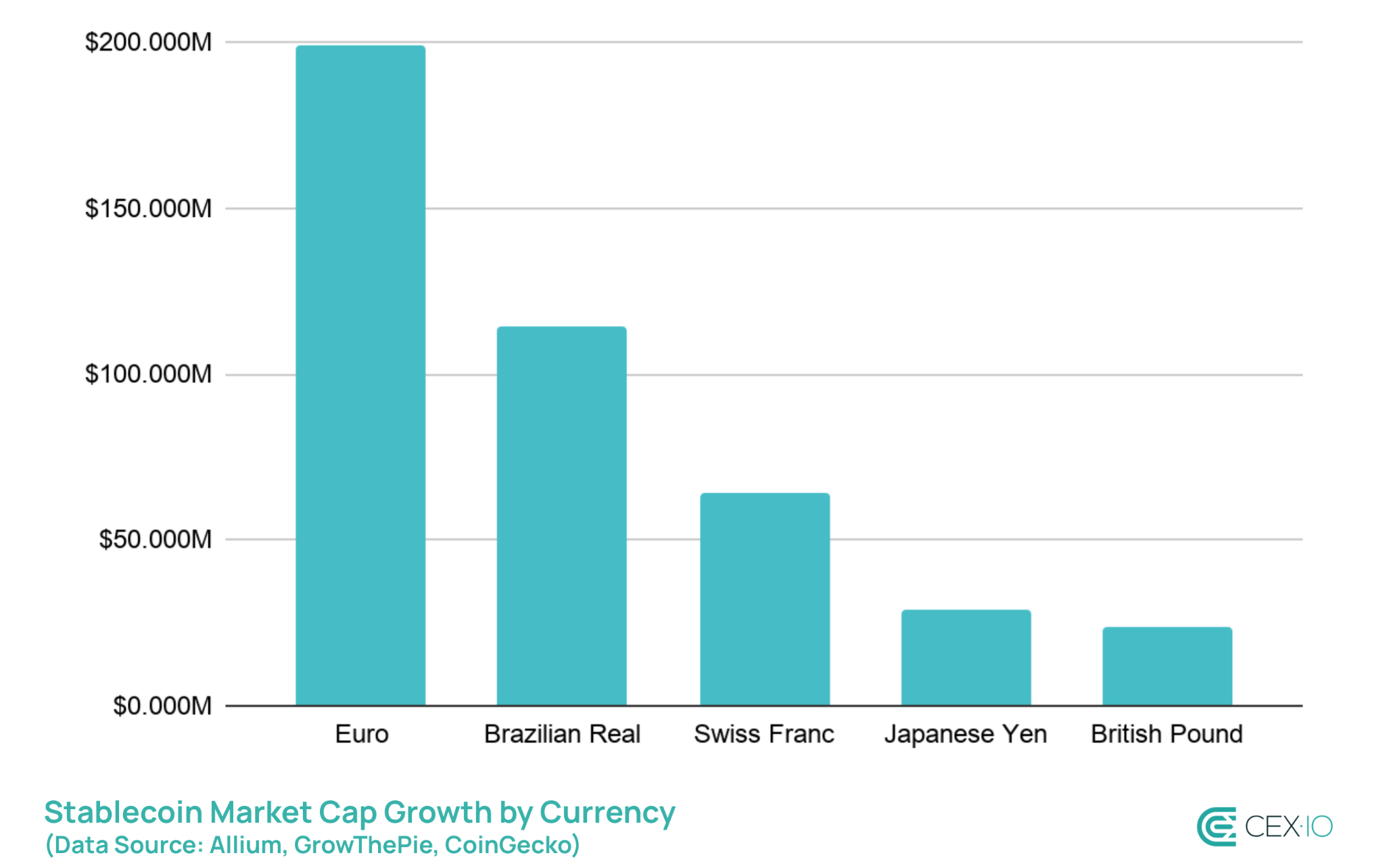
When it comes to the year’s biggest percentage gainers, they come with an obvious caveat: a small base. For instance, stablecoins pegged to Chilean peso and Nigerian naira saw an over 200% increase in 2026, but their market caps are still under $1 million.
The British pound is a partial exception: its stablecoin market cap grew 563% in native currency terms against just 2.5% M2 growth. However, this surge is largely fueled by a single stablecoin, tGBP, adding more than $20 million in market cap this year.
The more durable signals come from currencies with real scale behind them. Swiss franc stablecoins grew 183% against just 1.2% M2 growth, expanding above $100 million in market cap and surpassing JPY stablecoins.&
In addition, Brazilian real stablecoins saw its market cap grow 112% (vs. 4.9% M2 growth), exceeding $200 million and becoming the second-largest non-USD stablecoin after euro. That growth is largely attributed to BRLA gaining traction as payment rails inside local financial apps, including Avenia Pay.
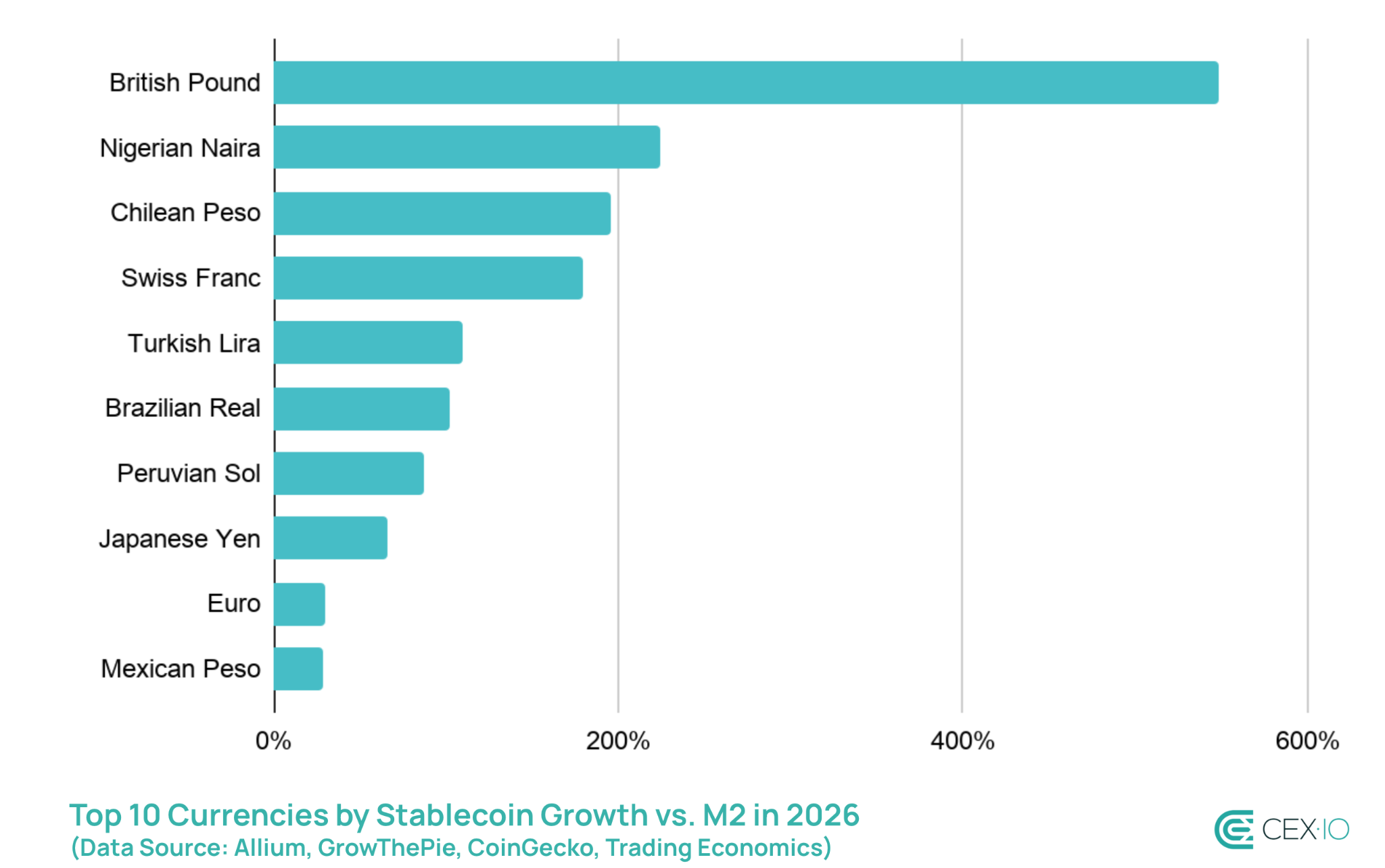
As for currencies where tokenization is losing ground, Argentine peso has been among the most prominent examples. It experienced a drop in stablecoin market cap by over 30% in 2026, partly due to a high-inflation economy where local money supply is expanding rapidly.
In countries where stablecoins could serve as an inflation hedge or savings tool, users appear to be moving away from local counterparts, likely in favor of dollar-denominated stablecoins instead.
Non-USD Stablecoins Are Growing Faster Than USD for the First Time Since Summer 2023
Over a trailing three-month window, USD stablecoin supply contracted roughly 4%, while non-USD stablecoins added around 3.7%. Such a divergence the market hasn’t seen in three years.
The last time this happened, in summer 2023, total stablecoin supply was trending down and non-USD stablecoins were stuck in a range. USD stablecoins fell for three straight months while non-USD ticked up slightly — a similar setup to today.
What is different this time is the base. Non-USD stablecoins aren’t just holding a range — they’ve broken through its $1.2 billion ceiling that capped them for several years and are now hovering near its all-time high at $1.8 billion. As a result, their share of total stablecoin supply rose to 0.59%, the highest level since October 2024.
The Infrastructure Is Broadening Too
Most notably, the growth isn’t confined to one chain. Ethereum ecosystem now hosts stablecoins denominated in 30 different currencies, a new all-time high, reinforcing its role as the default launchpad for new non-USD stablecoin issuance.&
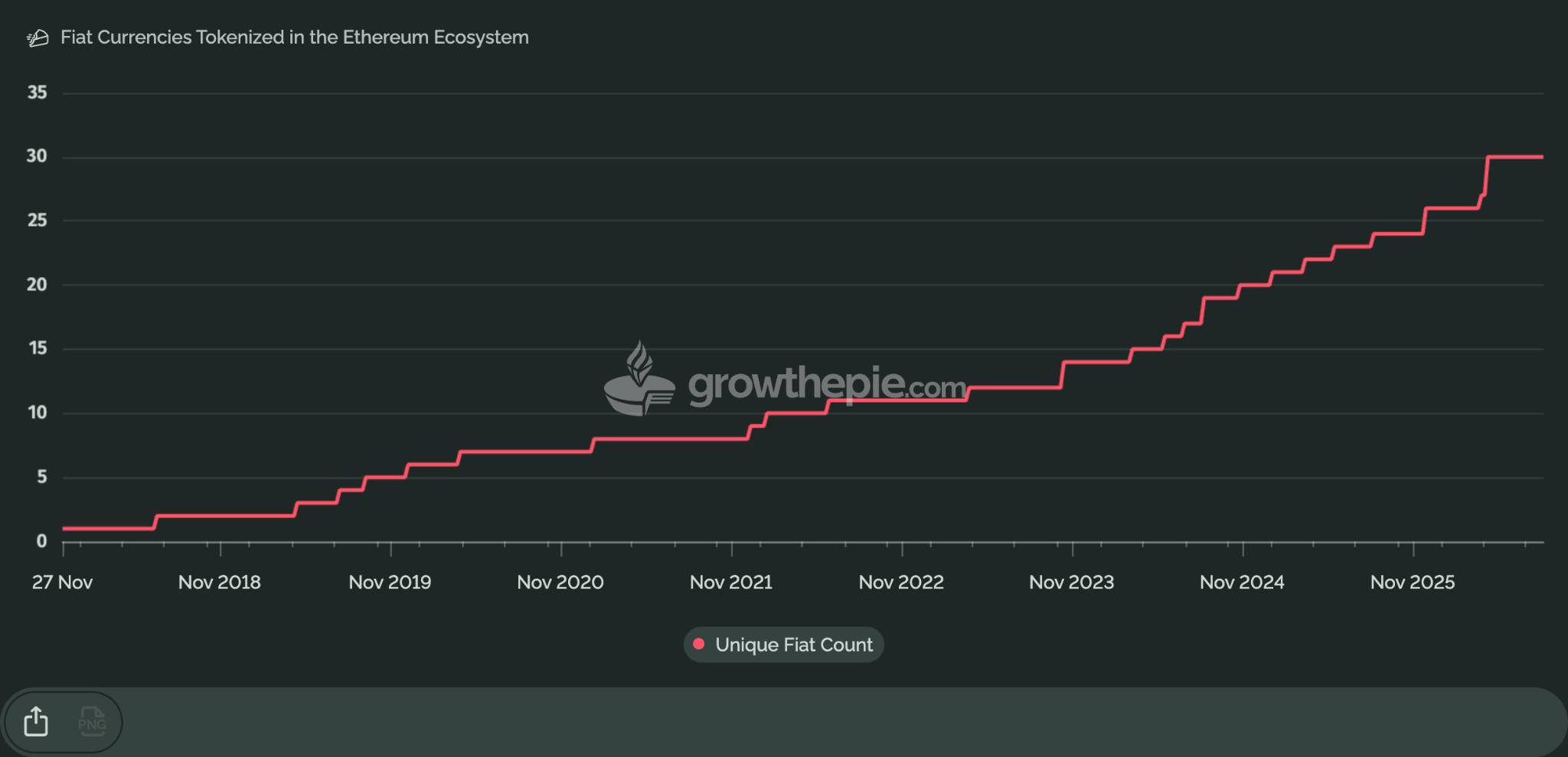
But its dominance is loosening: the combined share of Ethereum L1 and its L2s in non-USD stablecoin market cap fell from 65% to 58% over the course of 2026, as Tron, Solana, and Stellar picked up a growing share of issuance and activity.
Conclusion
Despite a notable surge this year, stablecoins still make up less than 0.01% of the local money supply for most currencies. By comparison, USD stablecoins currently account for 1.3% of the dollar’s M2. However, the USD had a significant head start, as crypto trading initially needed stable, predictable assets to trade against.
Stablecoins are now moving beyond that role. They are increasingly being used for payments, as BRLA adoption shows, and to reduce foreign exchange friction, which is supporting demand for XSGD. This is a slower path than the one USD stablecoins took, but the growth of non-USD stablecoins points to rising demand for these use cases.
As tokenization and RWA become more widely adopted, local stablecoins could see further growth by solving problems that go beyond trading.
Sources
The data used for this research consists of publicly available information from Allium, GrowThePie, CoinGecko, DeFiLlama, and Trading Economics.&
Money supply figures reflect each country’s M2 measure, with the exception of Australia, which does not publish an M2 figure — M1 was used instead. Stablecoin market cap denominated in native currencies and M2 figures were used to calculate local growth rates, while USD-denominated figures were used for absolute and cross-currency comparisons; exchange rates were applied where conversion was needed.&
The observation period for this study was focused on stablecoin and M2 performance in 2026, with data points ending August 21, 2026.
The web content provided by CEX.IO is for educational purposes only. The information and tools provided neither are, nor should be construed as, an offer, or a solicitation of an offer, or a recommendation, to buy, sell or hold any digital asset or to open a particular account or engage in any specific investment strategy. Digital asset markets are highly volatile and can lead to loss of funds.
The availability of the products, features, and services on the CEX.IO platform is subject to jurisdictional limitations. To understand what products and services are available in your region, please see our list of supported countries and territories. This page includes additional links to information about individual products, and their accessibility.

You can get bonuses upto $100 FREE BONUS when you:
💰 Install these recommended apps:
💲 SocialGood - 100% Crypto Back on Everyday Shopping
💲 xPortal - The DeFi For The Next Billion
💲 CryptoTab Browser - Lightweight, fast, and ready to mine!
💰 Register on these recommended exchanges:
🟡 Binance🟡 Bitfinex🟡 Bitmart🟡 Bittrex🟡 Bitget
🟡 CoinEx🟡 Crypto.com🟡 Gate.io🟡 Huobi🟡 Kucoin.











Comments